
Your material choice in 2026 will be the most critical strategic decision affecting your operational costs and quality risks.
The decision between PVC compounds1 and dry blend powder2 comes down to balancing upfront cost savings against production stability3. PVC compounds1 offer superior quality consistency4 and reduced R&D burden, while dry blend powder2 provides 8-12% direct cost advantages. Your optimal choice depends on your operational scale, market strategy5, and existing equipment capabilities.

At STAR PVC, we provide both solutions to meet your specific operational needs. After 15 years of manufacturing experience across 50+ countries, I've seen how the wrong material choice can impact entire production lines6. Let me share what we've learned about these two approaches.
What Are the Real Cost Differences Between PVC Compounds and Dry Blend Powder?
Direct material costs create the most obvious difference between these two options.
PVC dry blend powder2 offers 8-12% lower direct material costs because it eliminates compounding expenses. However, this advantage requires significant internal investment in mixing equipment, R&D teams, and quality control7 systems that can offset initial savings.
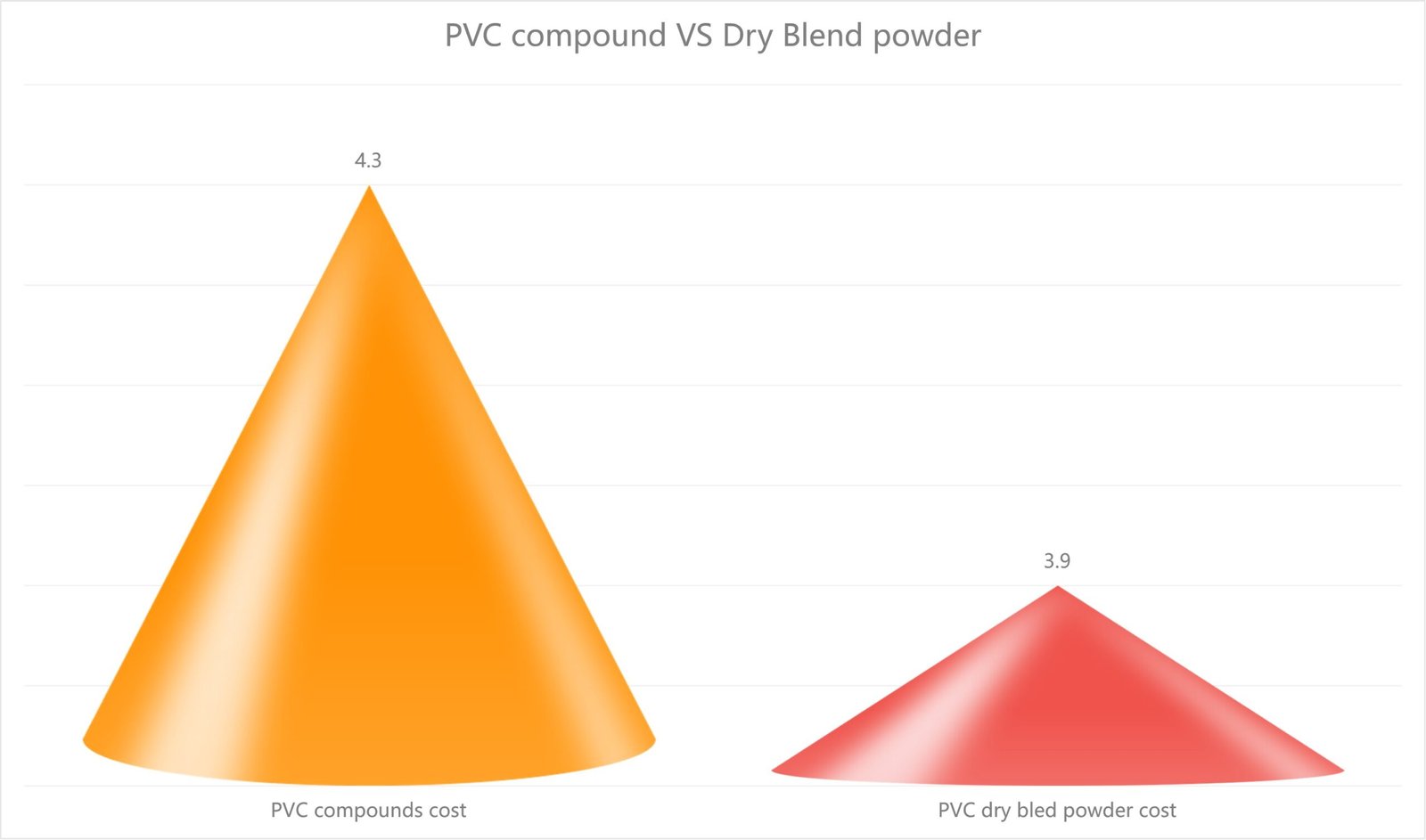
The cost equation extends far beyond material prices. When you choose dry blend powder2, you take full responsibility for formulation development8 and testing. This means hiring specialized R&D teams and investing in continuous testing protocols. I've worked with Canadian profile manufacturers who initially chose dry blend for cost savings but later switched to compounds when they calculated their total operational expenses.
For PVC compounds1, the higher direct cost includes our compounding, R&D, and quality control7 investments. You're essentially outsourcing these critical functions to specialists. In markets like India, where resin import tariffs9 are high, importing finished PVC compounds1 actually provides superior total cost advantages while reducing inventory and processing risks.
| Cost Factor | PVC Dry Blend Powder | PVC Compounds |
|---|---|---|
| Direct Material Cost | 8-12% lower | Higher upfront |
| R&D Investment | High internal cost | Outsourced to supplier |
| Equipment Requirements | Significant CAPEX | Minimal additional investment |
| Quality Control | Full internal responsibility | Supplier managed |
| Total Cost of Ownership | Variable based on scale | Predictable and stable |
How Do Quality Stability Risks Impact Your Production Line?
Quality consistency determines your production efficiency and waste rates more than any other factor.
PVC dry blend powder2 carries inherent quality stability risks due to open mixing processes and sensitivity to storage conditions. Batch-to-batch consistency becomes challenging, potentially increasing your waste rates and customer complaints.

Dry blend powder faces fundamental stability challenges. The open mixing process exposes materials to environmental variables. Humidity, temperature fluctuations, and storage duration all affect final product properties. I've seen manufacturers struggle with color variations and mechanical property inconsistencies that traced back to powder storage issues.
Our optimized packaging solutions help maintain dry blend advantages for select customers. We supply Canadian profile manufacturers with specially packaged dry blend that preserves cost benefits while minimizing quality risks. However, this requires strict handling protocols and climate-controlled storage.
PVC compounds1 undergo controlled compounding processes that ensure uniform quality and viscosity consistency. Our 15 production lines6, each staffed with 8+ years experienced engineers, maintain particle size uniformity ≥95% and moisture content ≤0.3%. This translates to predictable processing behavior and consistent end-product properties.
The risk-reward calculation depends on your quality tolerance and customer requirements10. High-end applications typically demand the consistency that only compounds can provide.
What Equipment and Infrastructure Requirements Should You Consider?
Capital expenditure requirements differ dramatically between these material choices.
Dry blend powder demands significant equipment investments including specialized mixing systems, precision weighing equipment, and dedicated storage facilities. PVC compounds1 run easily on most standard extrusion and injection molding equipment with minimal modifications.
Choosing dry blend powder2 means investing in comprehensive mixing infrastructure. You need accurate weighing systems, high-efficiency mixers, and temperature-controlled storage. These systems require regular calibration and maintenance. The initial CAPEX can reach hundreds of thousands of dollars for medium-scale operations.
Equipment complexity extends to operator training. Your team must understand mixing ratios, sequence timing, and quality testing protocols. Any deviation can affect entire production batches. I've watched companies underestimate these training requirements and face months of production inconsistencies.
PVC compounds1 integrate seamlessly with existing processing equipment. Most standard extruders and injection molding machines handle compounds without modifications. This compatibility reduces implementation time and minimizes production disruptions during material transitions.
Your existing equipment capabilities often determine the practical choice. Companies with established mixing infrastructure may leverage dry blend advantages, while those focused on core manufacturing processes typically benefit from compound simplicity.
Which Solution Aligns Best With Your Market Strategy and Scale?
Your operational scale and market positioning determine the optimal material strategy.
Large-scale manufacturers with dedicated R&D capabilities can maximize dry blend cost advantages, while companies prioritizing market responsiveness and quality consistency4 typically benefit more from compound solutions.
High-volume operations with stable product lines can absorb the infrastructure investments required for dry blend success. When you're producing millions of units annually, the 8-12% material cost savings create significant bottom-line impact. These companies typically maintain large technical teams capable of managing formulation complexities.
Medium-scale manufacturers often find compounds more strategic. The ability to quickly adjust formulations through supplier partnerships enables faster market response. When customer requirements10 change, we can modify compound specifications within days rather than the weeks required for internal R&D cycles.
Market positioning also influences material choice. Premium product manufacturers typically choose compounds for quality assurance, while cost-competitive segments may prioritize dry blend savings. Your brand reputation and customer expectations should guide this decision.
Geographic factors matter significantly. In regions with high import duties on resins, compound importation can provide unexpected cost advantages. Conversely, markets with established local mixing infrastructure may favor dry blend approaches.
At STAR PVC, we've optimized both pathways. Our Canadian customers successfully use our optimized dry blend packaging to maintain cost advantages while ensuring quality stability. Our global compound customers benefit from our ISO 9001 certified manufacturing and comprehensive technical support11.
Conclusion
Choose PVC compounds1 for quality stability and operational simplicity, or select dry blend powder2 for direct cost advantages with higher infrastructure investment requirements.
Explore the advantages of PVC compounds for quality and operational efficiency. ↩
Learn about dry blend powder and its cost-saving potential in manufacturing. ↩
Understand the key elements that influence production stability and efficiency. ↩
Find out how quality consistency impacts production efficiency and customer satisfaction. ↩
Explore how market strategy shapes material choices for manufacturers. ↩
Discover common challenges in production lines and how to overcome them. ↩
Discover effective quality control practices to ensure product reliability. ↩
Understand the process of formulation development and its importance in production. ↩
Find out how import tariffs can influence material costs and sourcing decisions. ↩
Learn how to align material selection with evolving customer needs. ↩
Explore the value of technical support in optimizing manufacturing processes. ↩
