
Are you struggling to find the right PVC profile granules supplier1? Still using traditional mixed powder methods that leave you unsatisfied with your final products?
Door and window profiles demand specific PVC granule properties: UV resistance2, structural rigidity3, excellent plasticization4, thermal stability5, consistent flow characteristics6, and zero impurities. PVC granules offer operational simplicity and customization but cost more, while mixed powders reduce material costs but increase labor, energy consumption, and equipment limitations.
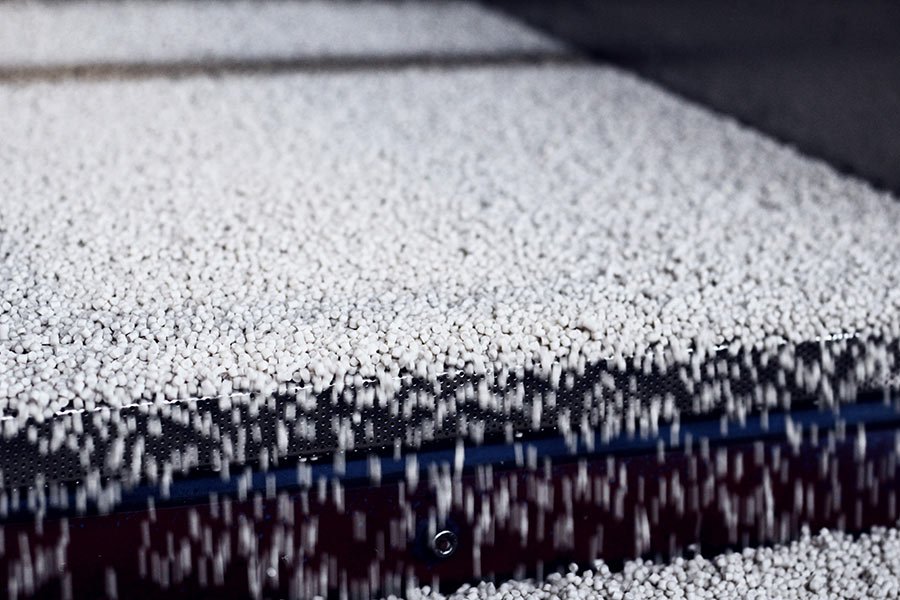
After 15 years in PVC compound manufacturing, I've seen countless manufacturers make costly mistakes by choosing the wrong materials. Let me share what really matters when selecting PVC materials for door and window profiles.
What specific properties must PVC granules have for door and window applications?
Door and window profiles face harsh outdoor conditions daily. Your material choice directly impacts product lifespan and customer satisfaction.
PVC granules for profiles require exceptional UV resistance2, high rigidity, superior plasticization with SG5 resin7, strong thermal stability5, consistent flowability, and complete freedom from contaminants to ensure long-lasting, dimensionally stable door and window frames.

UV Resistance: Your First Line of Defense
UV resistance2 tops the requirements list because door and window profiles spend their entire service life under direct sunlight. Without proper UV protection, your profiles will yellow, become brittle, and fail prematurely.
We incorporate specialized UV stabilizers and titanium dioxide into our formulations. Our testing shows profiles maintain their original color and mechanical properties even after 2000 hours of accelerated weathering tests. This translates to decades of real-world performance.
| Property | Requirement | Test Method | Our Standard |
|---|---|---|---|
| UV Resistance | No yellowing after 2000h | ASTM G154 | ΔYI ≤ 3.0 |
| Color Retention | Minimal fade | ISO 4892 | ΔE ≤ 2.0 |
| Brittleness | No cracking | ASTM D746 | -40°C pass |
Rigidity and Dimensional Stability
Your profiles must maintain their shape under thermal stress. Poor rigidity leads to warping, sagging, and operational failures that damage your reputation.
We achieve optimal rigidity through precise calcium carbonate loading and impact modifier selection. Our compounds maintain Vicat softening points above 78°C while preserving impact strength at low temperatures.
Plasticization and Processing Requirements
SG5 resin7 provides the ideal balance of processing ease and mechanical properties. However, resin quality varies significantly between suppliers. We source only premium-grade SG5 with consistent K-values and minimal impurities.
Proper plasticization ensures uniform melt flow during extrusion. Our compounds achieve complete fusion within the first third of your extruder barrel, preventing gel formation and surface defects.
Why choose PVC granules over traditional mixed powder methods?
The production method you choose affects everything from operational efficiency to final product quality. Let me break down the real differences.
PVC granules simplify operations through direct feeding into extruders and offer custom formulation flexibility8, but increase material costs. Mixed powders reduce raw material expenses but demand additional labor, higher energy consumption, dust management, and twin-screw extruder requirements.

Operational Simplicity with Granules
Using PVC granules transforms your production process. You simply feed the granules directly into your extruder hopper. No mixing, no dust, no additional equipment needed.
I've watched manufacturers reduce their setup time from 2 hours to 15 minutes by switching to granules. Your operators focus on extrusion parameters rather than material preparation. This consistency improves product quality and reduces waste.
Customization Advantages:
- Formula modifications based on your specific requirements
- Color matching to exact specifications
- Property adjustments for different climate conditions
- Technical support throughout the process
Cost Considerations:
- Higher material cost per kilogram
- Lower labor requirements
- Reduced equipment maintenance
- Minimal dust extraction needs
Mixed Powder: Cost vs Complexity
Mixed powders offer material cost savings, typically 8-12% lower than equivalent granules. However, the total cost picture includes factors many manufacturers overlook.
Additional Requirements:
- Dedicated mixing personnel (2-3 operators)
- High-speed heating/cooling mixers
- Color dosing equipment
- Dust extraction systems
- Twin-screw extruder mandatory (single-screw cannot process)
Hidden Costs:
- Increased electricity consumption (mixing equipment)
- Higher maintenance on mixing machinery
- Dust management and environmental compliance
- Quality variation between batches
- Longer setup and changeover times
| Factor | PVC Granules | Mixed Powder |
|---|---|---|
| Material Cost | Higher | Lower |
| Labor Cost | Lower | Higher |
| Energy Cost | Lower | Higher |
| Equipment Investment | Lower | Higher |
| Quality Consistency | Higher | Variable |
| Setup Time | 15 minutes | 2 hours |
Equipment Compatibility Limitations
This point often surprises manufacturers: mixed powders work only with twin-screw extruders. Single-screw machines cannot achieve proper mixing and plasticization with powder blends.
If you're operating single-screw equipment, granules are your only viable option. Twin-screw lines handle both, but granules still offer superior consistency and easier processing.
What quality standards should you demand from suppliers?
Quality standards separate professional suppliers from commodity traders. Your supplier's capabilities directly impact your production success.
Demand suppliers provide ISO 9001 certification9, RoHS/REACH compliance, batch-to-batch consistency data, complete material safety documentation, and comprehensive technical support including formula customization and processing guidance.

Essential Certifications and Testing
Every shipment should include complete test reports covering mechanical properties, thermal stability5, and environmental compliance. We provide:
Physical Properties:
- Tensile strength and elongation
- Impact resistance at multiple temperatures
- Vicat softening point
- Melt flow rate
Chemical Compliance:
- RoHS heavy metals testing
- REACH SVHC verification
- Plasticizer identification and content
- Stabilizer system disclosure
Batch Consistency Guarantees
Consistency matters more than absolute values. A supplier claiming perfect properties but delivering variable quality will disrupt your production.
We maintain batch-to-batch variation within ±2% for all critical properties. Our quality system tracks every raw material lot through finished product, enabling complete traceability.
Technical Support Capabilities
Your supplier should function as a technical partner, not just a material vendor. Look for suppliers offering:
- Formula modification based on your requirements
- Processing parameter optimization
- Troubleshooting support during production issues
- Market trend insights and new development collaboration
Conclusion
Choose PVC granules for operational simplicity and consistent quality, or mixed powders for cost savings with increased complexity. Both require suppliers with proven technical capabilities and quality systems.
Explore top suppliers to ensure you get high-quality PVC granules for your manufacturing needs. ↩
Learn about the significance of UV resistance in prolonging the lifespan of your PVC products. ↩
Understand how rigidity impacts the durability and performance of your door and window profiles. ↩
Discover how proper plasticization can enhance the processing and quality of your PVC products. ↩
Find out why thermal stability is crucial for maintaining the integrity of PVC profiles. ↩
Explore how consistent flow can improve production efficiency and product quality. ↩
Understand the role of SG5 resin in achieving optimal mechanical properties in PVC. ↩
Learn how customization can meet specific production needs and enhance product performance. ↩
Learn about the significance of ISO 9001 certification in ensuring quality from suppliers. ↩
