
Have you ever struggled with brittle, fragile rigid PVC products that crack under the slightest pressure? This frustrating problem has cost manufacturers thousands in wasted materials and damaged reputations.
Rigid PVC brittleness1 stems from poor plasticization in the raw material2, inadequate machine settings3, and improper molding parameters. The primary cause is using PVC compounds4 with insufficient plasticizer effectiveness5, leading to incomplete fusion during processing.

Over my 15 years in PVC compound manufacturing, I've helped hundreds of clients solve this exact problem. Let me share the real reasons behind brittle PVC products and how to fix them.
What Makes PVC Compounds Prone to Brittleness During Processing?
Many manufacturers blame their equipment first, but the root cause often lies in the raw material quality6. Poor PVC compounds4 create processing nightmares that no machine adjustment can fix.
The primary culprit is inadequate plasticizer distribution in PVC compounds4. When plasticizers don't properly integrate with PVC resin during compounding, the material becomes difficult to process and results in brittle final products.

I've seen this countless times with new clients who switch to us after struggling with their previous suppliers. Their PVC compounds4 looked fine on paper but failed miserably in production. The issue wasn't visible until they started processing.
Effective plasticization requires precise temperature control during compound manufacturing. Our facility maintains strict temperature profiles across all 15 production lines. Each batch undergoes thermal analysis7 to ensure proper plasticizer integration. When plasticizers distribute evenly throughout the PVC matrix, the compound flows better during processing and creates stronger molecular bonds in the final product.
The molecular structure8 tells the whole story. Well-plasticized PVC compounds4 have uniform polymer chains that move freely during heating. Poor compounds show irregular chain distribution, creating weak points that become crack initiation sites. We use specialized testing equipment to verify molecular uniformity before shipping any batch to customers.
How Do Machine Settings Affect PVC Product Toughness?
Your processing equipment plays a crucial role in determining final product quality. Even the best PVC compounds4 can produce brittle products if machine parameters9 aren't optimized correctly.
Insufficient electrical current and power settings prevent complete plasticization during injection molding10 or extrusion. Higher current increases barrel temperatures, improving material flow and molecular fusion for enhanced product toughness.

I remember working with a client in Germany who complained about brittle pipe fittings. Their PVC compound tested perfectly in our lab, but their production yielded weak parts. After reviewing their machine settings, we discovered their injection molding10 machine operated at 30% below optimal power levels.
Machine current directly affects barrel heating efficiency. Low current means uneven heating, which creates temperature gradients in the molten PVC. These gradients cause incomplete fusion between polymer chains. When the part cools, these unfused areas become stress concentration points that lead to premature failure.
Feed rate optimization is equally critical. Insufficient material feed starves the screw, creating pressure drops that affect melt quality. Our technical team recommends maintaining consistent feed rates that keep the screw fully loaded. This ensures steady pressure and temperature throughout the plasticization zone.
Screw speed must match material characteristics. Too fast creates excessive shear heating that degrades PVC. Too slow results in incomplete mixing and poor plasticization. We provide specific screw speed recommendations for each compound formulation based on our extensive processing trials.
Why Does Mold Pressure Determine Product Durability?
Mold pressure directly influences how PVC molecules align and bond during the cooling phase. Incorrect pressure settings create internal stresses that weaken the final product structure.
Optimal mold pressure11 ensures complete cavity filling and proper molecular orientation. Insufficient pressure creates voids and weak spots, while excessive pressure induces internal stresses that cause delayed cracking in finished products.
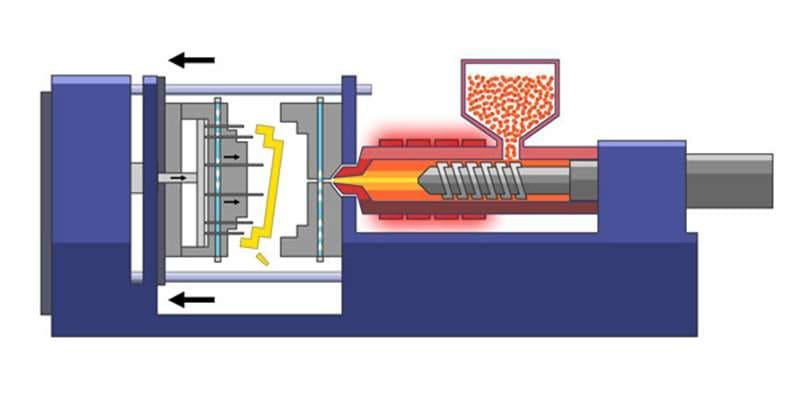
Pressure requirements vary significantly based on part geometry and wall thickness. Thin-walled products need higher pressures to ensure complete filling before the material solidifies. Thick sections require moderate pressure to prevent sink marks and internal voids.
I've developed pressure calculation formulas based on part complexity and PVC compound viscosity. Simple geometries typically need 80-120 MPa injection pressure. Complex parts with multiple flow paths may require 150-200 MPa. These calculations account for pressure losses through runners and gates.
Holding pressure duration is just as important as peak pressure. PVC continues shrinking during cooling, so maintaining pressure prevents void formation. Our recommended holding time equals 0.8 times the cooling time for optimal results. This ensures the gate remains pressurized until the part develops sufficient strength to maintain its shape.
Pressure profiling throughout the injection cycle optimizes molecular alignment. We recommend starting with 70% of maximum pressure for initial filling, then ramping to full pressure for packing. This two-stage approach prevents overpacking while ensuring complete cavity filling.
How Can Raw Material Quality Prevent Brittleness Issues?
The foundation of tough PVC products starts with properly formulated compounds. Quality raw materials make the difference between success and costly production failures.
High-quality PVC compounds4 feature optimized plasticizer systems, impact modifiers12, and processing aids13 that enhance flow properties and final product toughness. Premium formulations enable low-temperature processing while maintaining excellent mechanical properties.

Our compound formulations undergo extensive testing before reaching customers. We test tensile strength14, impact resistance, and thermal stability across multiple processing conditions. Many of our compounds achieve tensile strength14s exceeding 40 MPa, far surpassing standard industry requirements.
Plasticizer selection determines processing behavior and final properties. We use specialized plasticizer blends that activate at lower temperatures, reducing energy costs while improving product quality. These advanced systems provide better compatibility with PVC resin, creating stronger intermolecular bonds.
Impact modifier technology has advanced significantly in recent years. Our latest formulations incorporate core-shell rubber particles15 that absorb impact energy without compromising rigidity. These modifiers distribute evenly throughout the PVC matrix, creating a network that prevents crack propagation.
Processing aid systems enhance material flow without affecting final properties. Our proprietary aid combinations reduce processing temperatures16 by 15-20°C while improving surface finish quality. Lower processing temperatures16 preserve PVC molecular structure8, resulting in tougher final products.
Conclusion
Brittle PVC products result from poor compound quality, incorrect machine settings, and improper molding parameters working together to create weak, failure-prone parts.
Understanding the causes of Rigid PVC brittleness can help manufacturers improve product quality and reduce waste. ↩
Exploring the role of plasticization can lead to better processing techniques and stronger PVC products. ↩
Learning about machine settings can help optimize production processes and enhance product durability. ↩
Discovering best practices can improve the quality and performance of PVC products. ↩
Understanding plasticizer effectiveness is crucial for achieving optimal material properties in PVC. ↩
High-quality raw materials are essential for producing durable and reliable PVC products. ↩
Thermal analysis ensures proper plasticizer integration, leading to stronger and more reliable PVC products. ↩
Exploring molecular structure can provide insights into improving the toughness and durability of PVC products. ↩
Identifying critical machine parameters can help manufacturers avoid brittleness and enhance product performance. ↩
Learning best practices in injection molding can significantly improve the quality of PVC products. ↩
Understanding mold pressure can help manufacturers optimize their processes for stronger final products. ↩
Exploring impact modifiers can lead to innovations in PVC formulations that enhance toughness. ↩
Understanding processing aids can help manufacturers achieve better flow properties and product quality. ↩
Learning about tensile strength can help manufacturers ensure their products meet industry standards. ↩
Discovering the benefits of core-shell rubber particles can lead to improved impact resistance in PVC products. ↩
Understanding the impact of processing temperatures can help optimize manufacturing for better results. ↩
