
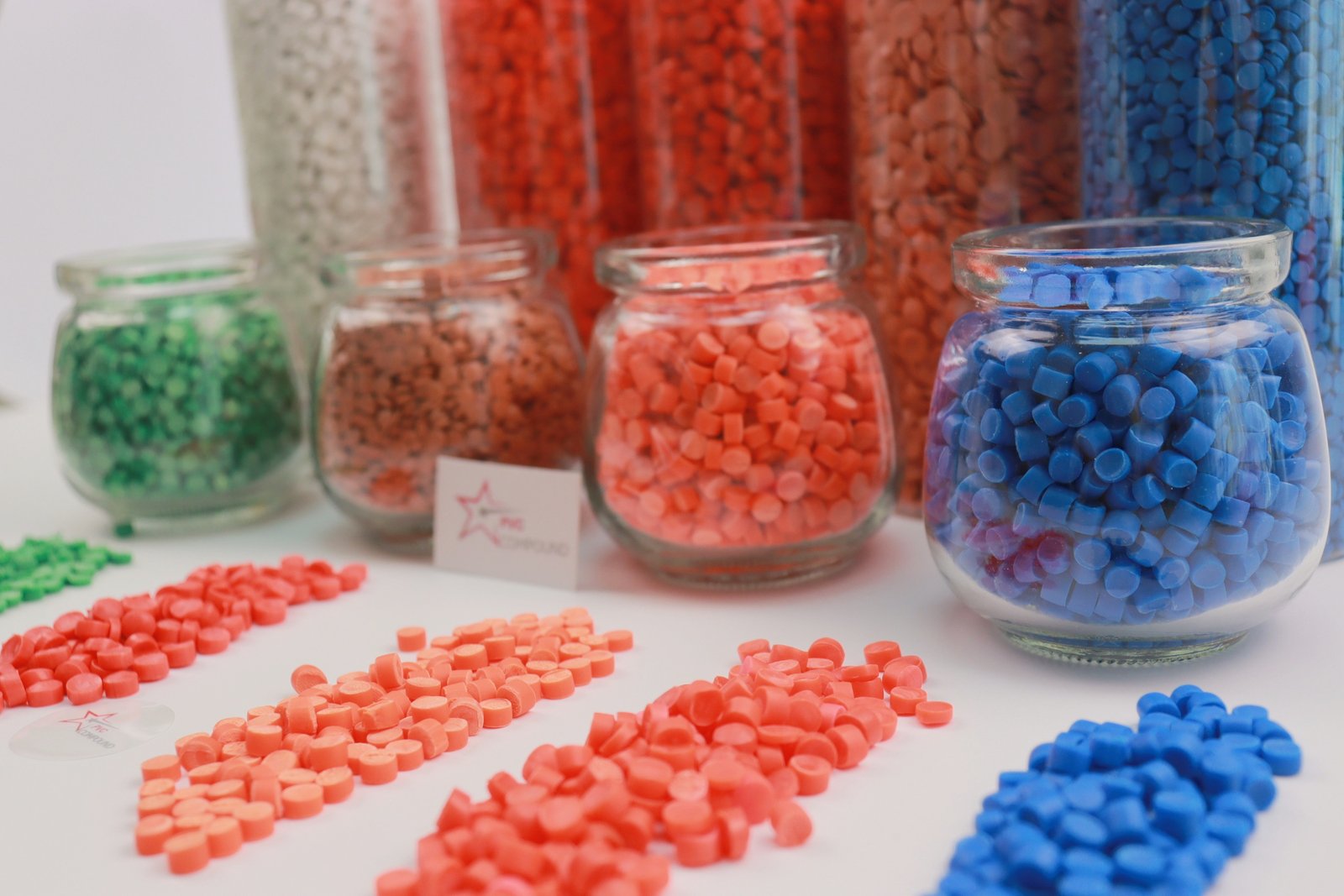
Struggling to tell PVC shoe soles apart? The wrong choice means poor comfort and durability. Understanding the differences is key to selecting the perfect material for your footwear production line.
The primary difference lies between solid and foamed PVC soles. Solid soles are heavy, dense, and rigid, ideal for durability. Foamed soles are lighter due to internal air pockets and vary greatly in feel, density, and performance depending on the specific foaming method used.
For over 15 years, I've been helping manufacturers navigate the world of PVC compounds. I've seen firsthand how choosing the right material can completely transform a product's success. It's not just about getting any PVC granule; it's about getting the right PVC granule for the job. Let's break down the different types of PVC soles so you can make an informed decision for your next project.
How Can You Tell Solid and Foamed PVC Soles Apart?
You're looking at two similar shoe soles. How do you know which is heavy-duty and which is lightweight and cushioned? A simple hands-on test reveals the difference instantly.
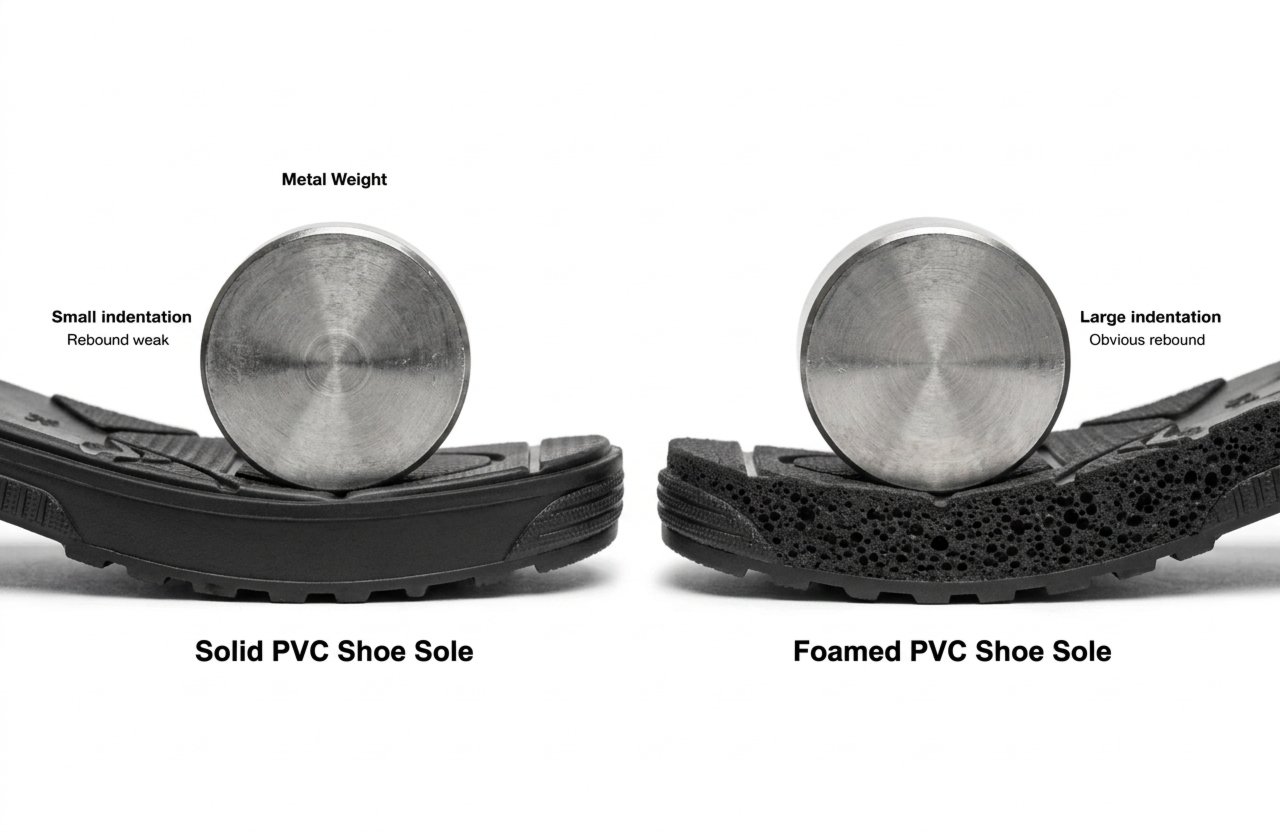
To distinguish them, use weight and pressure. A solid PVC sole will be noticeably heavier for its size and will not compress or rebound when you press on it. A foamed sole is much lighter and will have some degree of springiness or give under pressure.
When I first started in this business, a client was developing a new line of work boots. They wanted durability above all else. We provided them with our rigid PVC compound for solid soles. A few months later, they wanted to launch a line of casual sandals and asked for the same compound. I had to explain that while it was durable, it would be far too heavy and stiff for a comfortable sandal. This experience highlighted the importance of understanding the fundamental difference between solid and foamed soles.
Solid soles are just that—solid. There are no internal pores or bubbles. This density makes them incredibly tough and resistant to wear and tear. On the other hand, foamed soles are lighter because we introduce air pockets into the material during production. The size, shape, and structure of these pockets determine the final characteristics of the sole.
Here’s a simple breakdown:
| Feature | Solid PVC Sole | Foamed PVC Sole |
|---|---|---|
| Weight | Heavy | Light |
| Feel | Hard, no rebound | Varies from soft to firm, has rebound |
| Structure | Dense, no internal pores | Contains internal air pockets/cells1 |
| Best For | Safety shoes, rain boots, durable sandals | Casual shoes, slippers, athletic shoes |
What Exactly is a Skin-Foamed PVC Sole?
You find a sole that is firm on the outside but feels surprisingly light. Is it durable? Is it comfortable? This unique combination is the hallmark of a skin-foamed PVC sole.
A skin-foamed sole features a dense, solid outer layer (the "skin") with a foamed inner core. The boundary between the skin and the closed-cell core is very distinct. It's typically made by injecting PVC powder mixed with a foaming agent during production.
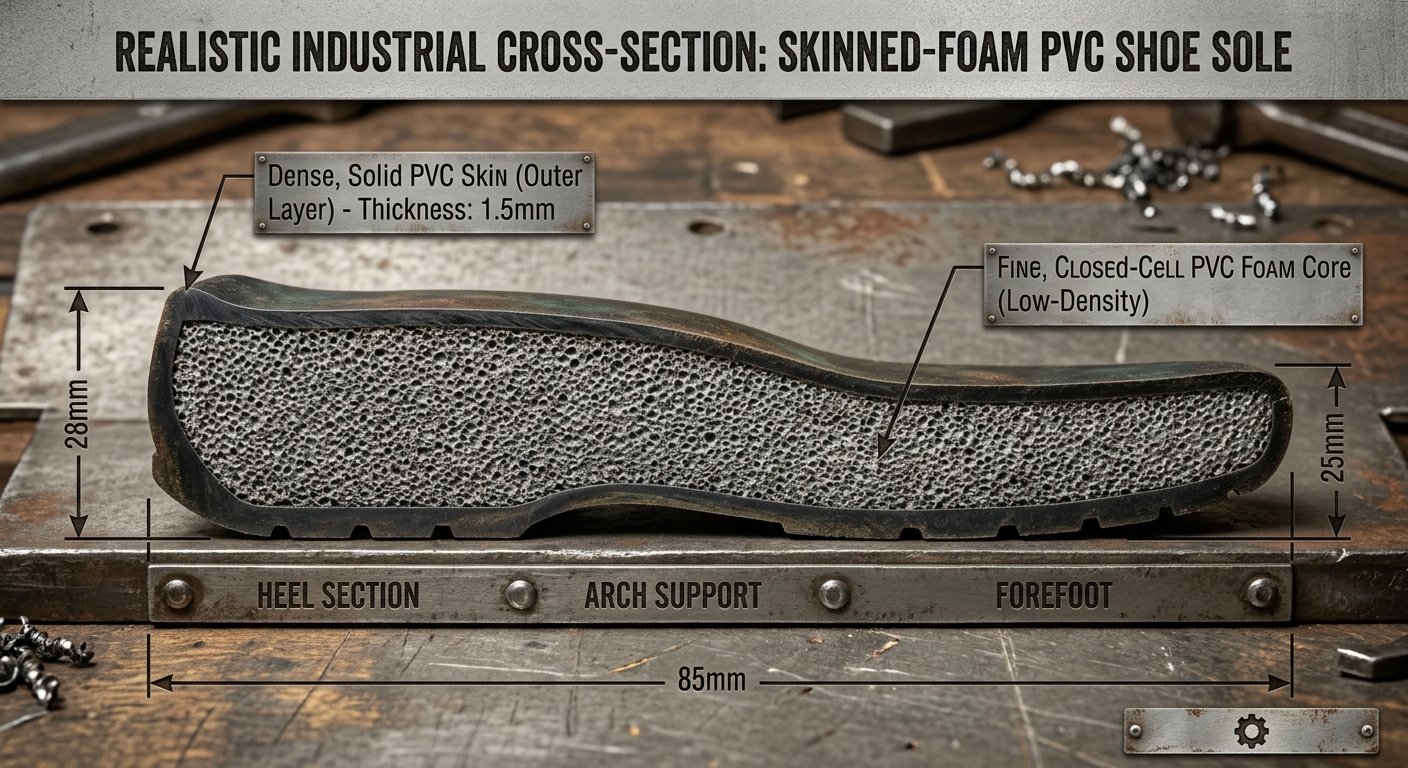
This method is quite clever. As a manufacturer, we often supply the base PVC compound as a powder. Our clients then add the AC foaming agent and pigments themselves right before the injection molding process. As the material is injected, the heat activates the foaming agent. The portion of the material that touches the cold mold surface cools rapidly, forming a solid, dense skin.2 The material in the center remains hot for longer, allowing the foaming agent to create a cellular core.
This structure provides the best of both worlds. The tough outer skin offers excellent wear resistance and a clean finish, while the foamed core reduces weight and adds a layer of cushioning.3 It's a cost-effective way to achieve a premium feel without the cost of more advanced processes. We see this used widely in:
- Mid-range casual shoe soles
- Foamed interlayers for rain boots
- Thick-soled platform slippers and sandals
For a customer looking to upgrade their basic solid-sole sandals, this is often the first technology I recommend. It elevates the product's comfort and perceived value significantly.
Why Are Some PVC Soles So Incredibly Soft and Light?
You've seen those ultra-thick, feather-light slippers. They feel incredibly soft at first but seem to flatten out quickly. This is a classic sign of a sole made with air-blowing technology.
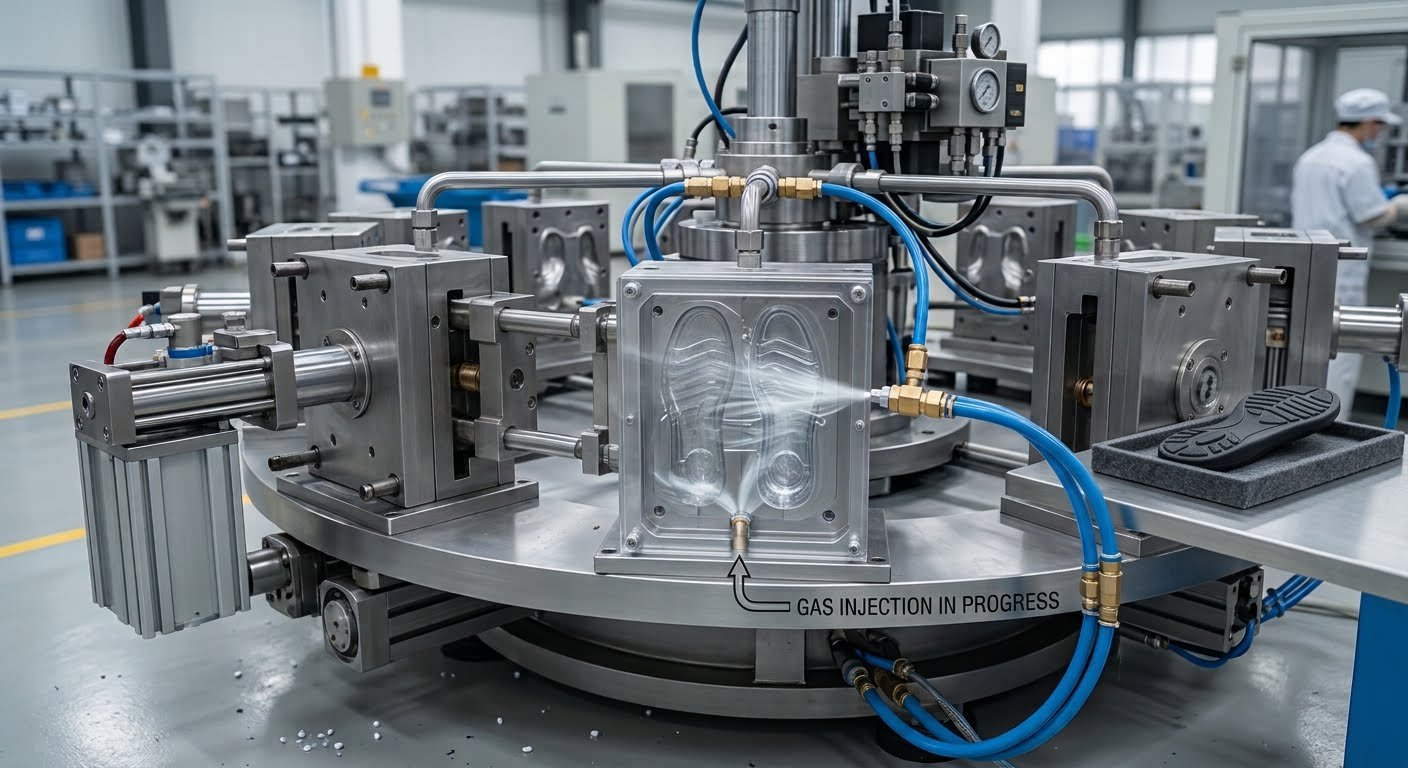
Air-blowing foaming is best done using PVC granules. During the injection process, air is blown into the mold4. This creates a large, hollow internal cavity surrounded by a thin shell of foamed PVC, making the sole extremely lightweight but offering very little structural support5.
Unlike other methods that create a uniform structure of small foam cells, air-blowing creates one big pocket of air. When you press on the sole, you're mostly compressing this large air cavity, which is why it feels so soft. The rebound is slow because it takes time for the deformed PVC shell to return to its original shape.
I remember a client who came to us with a single request: "Make me the lightest, cheapest thick-soled slipper possible." Air-blowing was the obvious solution. However, I made sure to manage their expectations regarding durability. Because the structure offers poor support, it's not suitable for shoes meant for extensive walking or bearing significant weight. The sole can feel like it's "bottoming out" quickly.
This is why you'll almost exclusively find this technology used in:
- Inexpensive, thick-soled "height-increasing" slippers
- Beach sandals and flip-flops
It's a perfect choice for low-cost, comfort-focused indoor footwear, but it is not the right choice for anything requiring performance or longevity.
How Are Uppers and Soles Fused into One Seamless Shoe?
Some shoes look perfectly seamless, with no glue marks or stitching where the upper meets the sole. How is this strong, clean bond achieved? This is the work of the Direct Injection Process (DIP).
The Direct Injection Process, or DIP, molds the molten PVC sole directly onto the finished shoe upper inside the machine6, creating a single, integrated unit. This process requires special PVC granules with excellent adhesive properties. The resulting foam is dense, with a quick rebound and reliable support.
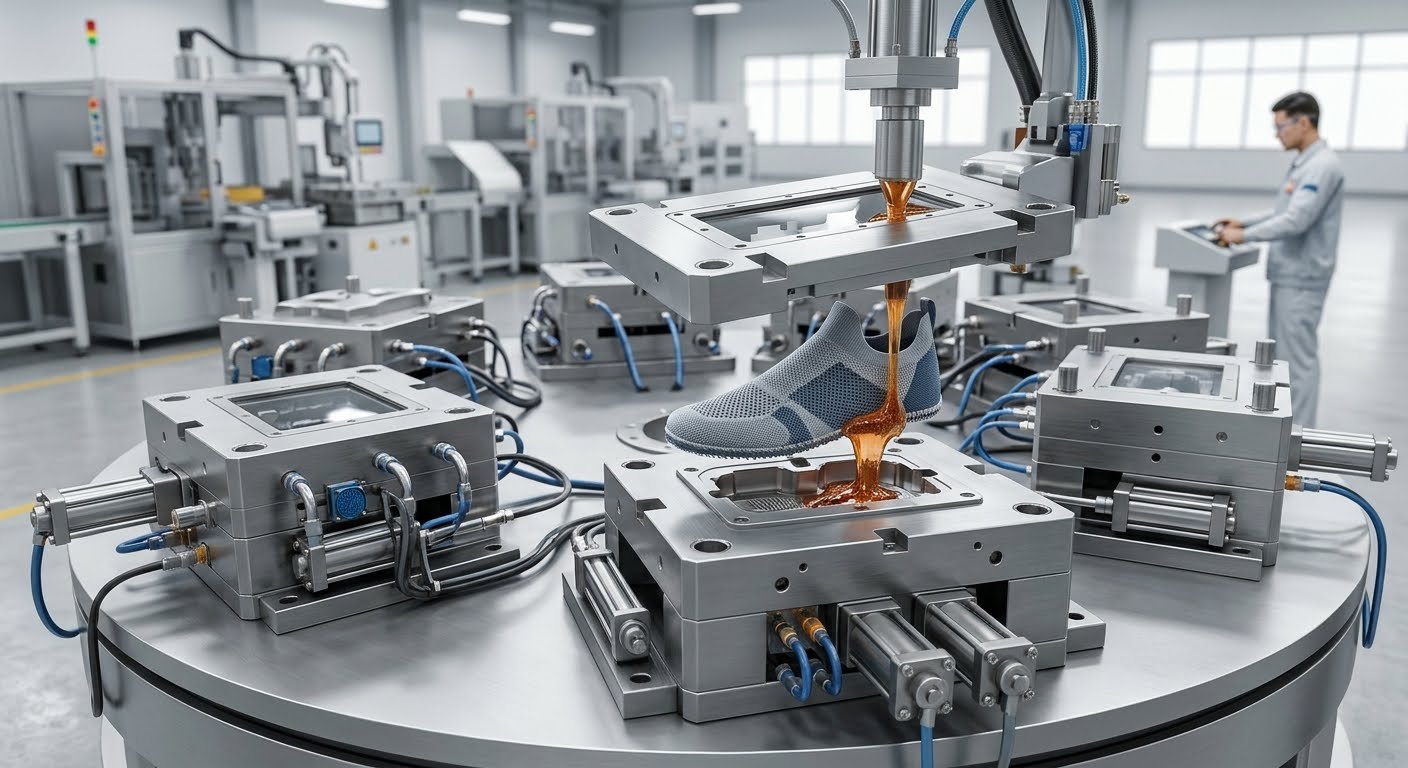
We call the finished products "DIP shoes," and they have become incredibly popular in recent years. The magic lies in the PVC compound itself. We formulate our DIP granules to have a specific viscosity and thermal profile, allowing them to flow perfectly into the mold and form a chemical bond with the upper material as they cool. This bond is often stronger than the materials themselves, eliminating the risk of sole separation that can happen with glued shoes7.
The foam structure in a DIP sole is also superior to air-blown types. It's much denser and more uniform, providing a great balance of cushioning and firm support. This makes it an ideal choice for shoes that need to be both comfortable and durable. We supply our DIP-specific PVC granules to many brands that produce:
- Athletic shoes
- High-quality casual shoes
- School shoes
The clean aesthetic and unmatched durability of DIP footwear make it a top choice for manufacturers looking to produce a reliable, high-quality product.
What Makes Premium PVC Soles Feel So Uniform and Bouncy?
You pick up a high-end slipper and notice the sole feels different. It's incredibly smooth, uniformly dense, and has a lively bounce. Why does it feel so much better? This is the result of advanced microsphere foaming technology.
This high-performance method uses special PVC granules made with microsphere foaming agents. Instead of a chemical reaction, it relies on the physical expansion of tiny, pre-made spheres. This creates an extremely fine, uniform, and fully closed-cell foam structure, delivering superior feel, rebound, and durability.
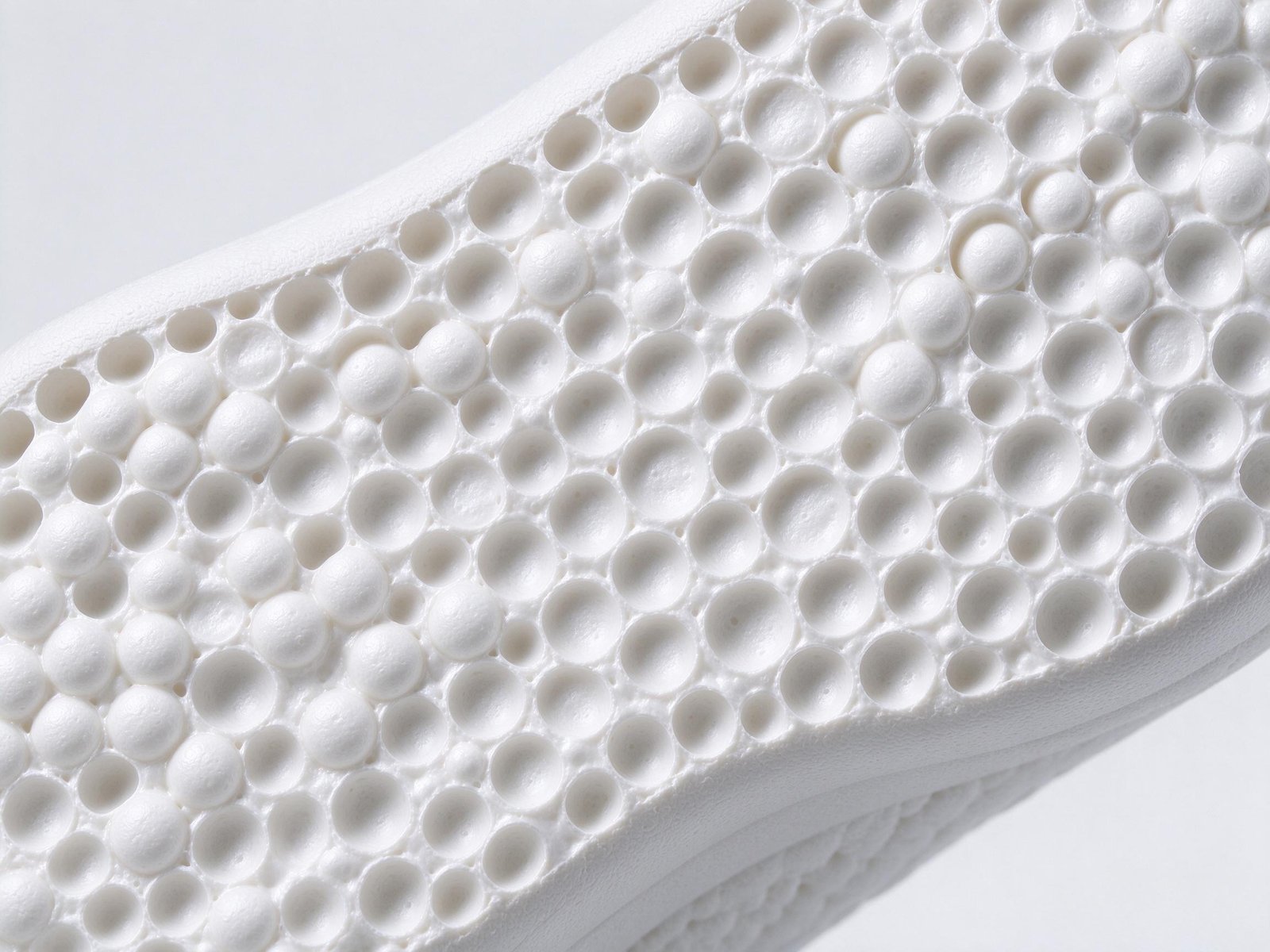
The science here is what sets it apart. A standard AC foaming agent decomposes with heat to create nitrogen gas, which forms bubbles of varying sizes. Microspheres, however, are tiny polymer shells containing a gas. When heated, the gas expands, and the shells swell like tiny balloons, creating a perfectly even and fine foam structure. The result is a sole that feels almost like a dense cream or a fine sponge.
This structure provides remarkable performance benefits. The hand-feel is delicate and smooth. The rebound is noticeably quicker and more energetic than standard AC foam. Most importantly, it has a very low compression set, which means it resists collapsing or "packing out" over time, even with repeated use. We worked with a children's shoe brand that switched to our microsphere PVC granules specifically for this reason; they needed a sole that provided consistent support and cushioning for growing feet.
While it can be slightly heavier and more expensive than a standard AC foamed sole, the performance justifies the cost for premium applications like:
- High-quality orthopedic slippers
- Premium children's shoe soles
- Any application needing stable, collapse-resistant foam
Conclusion
Choosing the right PVC sole comes down to your application. Understanding the differences between solid, skin-foamed, air-blown, DIP, and microsphere types ensures you get the exact performance, cost, and quality you need.
"Foam", https://en.wikipedia.org/wiki/Foam. A standard definition of polymer foam describes it as a two-phase material with gas cells dispersed in a polymer matrix, supporting the description of foamed PVC as containing internal cells. Evidence role: definition; source type: encyclopedia. Supports: Foamed PVC soles contain internal air pockets or cells.. ↩
"Formation of integral skin polyurethane foams - ADS", https://ui.adsabs.harvard.edu/abs/1999PESci..39..164G/abstract. A polymer-processing reference on structural or integral-skin foam molding can support that rapid cooling at the mold wall suppresses cell growth and creates a denser surface layer while the hotter interior continues foaming. Evidence role: mechanism; source type: research. Supports: In skin-foamed molding, contact with the cooler mold wall forms a dense outer skin while the interior foams.. Scope note: This would support the processing mechanism generally and may not cover the exact production parameters used for PVC soles. ↩
"Microcellular & Integral Skin Polyurethane Foam", https://polyurethanelaboratories.com/polyurethane-foam/microcellular-integral-skin/. A source on integral-skin foams can support that dense skins improve surface toughness and finish while cellular cores reduce weight and can improve cushioning, giving contextual support to the claimed performance balance. Evidence role: general_support; source type: education. Supports: Skin-foamed soles combine surface durability and finish with lower weight and cushioning from the foamed core.. Scope note: The performance depends on formulation and molding conditions, so the source would not prove all skin-foamed PVC soles have excellent wear resistance. ↩
"Gas-Assisted Injection Molding", https://www.xometry.com/resources/injection-molding/gas-assist-injection-molding/. A source on gas-assisted injection molding can support that pressurized gas introduced during molding can displace molten polymer and create hollow sections within molded parts. Evidence role: mechanism; source type: research. Supports: Air or gas introduced during molding can create hollow internal cavities in molded polymer parts.. Scope note: Gas-assisted injection molding literature supports the hollowing mechanism generally; it may not describe this footwear process under the same trade terminology as “air-blowing.” ↩
"Elastic polymer that is both stiff and tough, resolves long- ...", https://seas.harvard.edu/news/2021/10/elastic-polymer-both-stiff-and-tough-resolves-long-standing-quandary. A mechanics or materials source on hollow polymer structures and cellular foams can support that large voids reduce load-bearing cross-section and stiffness compared with denser, more uniform structures. Evidence role: mechanism; source type: paper. Supports: A sole with a large hollow cavity and thin shell offers less structural support than a denser or uniformly foamed sole.. Scope note: This supports the structural principle but not a measured support rating for the specific slipper soles discussed. ↩
"Direct Injection Moulding in Footwear", https://thefootwearedge.com/direct-injection-moulding/. A footwear-manufacturing reference can support that direct injection or direct soling forms the outsole by injecting molten polymer onto the upper, creating the sole-upper assembly without a separate cementing step. Evidence role: definition; source type: education. Supports: The Direct Injection Process forms a sole directly on the shoe upper inside the molding machine.. Scope note: Some direct-injection systems use polyurethane or thermoplastic rubber rather than PVC, so the source should be checked for PVC applicability or used as process context. ↩
"How to Repair Shoes with Separating Soles | DIY Shoe Glue ...", https://www.youtube.com/watch?v=wlXBEB3pwWQ&vl=en. A footwear-engineering or adhesion-testing source can support that direct-molded sole-upper constructions avoid a separate adhesive bond line, a known failure point in cemented footwear. Evidence role: mechanism; source type: research. Supports: Direct injection reduces the sole-separation risk associated with glued footwear by removing the separate adhesive joint.. Scope note: Direct injection can reduce adhesive-bond failure risk, but it does not eliminate all possible sole-separation failures across all materials and conditions. ↩
