
Are you confused about whether to choose PVC compound or PVC resin for your manufacturing needs? This choice affects your production efficiency, costs, and product quality in ways you might not expect.
PVC resin is pure polymer powder1 that requires additional processing2, while PVC compound is ready-to-use granules with pre-mixed additives3 that can be directly fed into production equipment.

After 15 years of manufacturing PVC compounds at our facility in Zhejiang, I've seen countless customers make costly mistakes by choosing the wrong material type. Let me share what I've learned about these two essential PVC materials.
What Exactly Is PVC Resin and How Does It Work?
Most manufacturers don't realize that PVC resin is just the starting point. You're dealing with raw chemical building blocks that need significant processing before they become useful.
PVC resin is pure polyvinyl chloride polymer powder extracted from petroleum and chlorinated with chlorine molecules. It contains no additives and serves as the base material for all PVC processing.
PVC resin represents the most basic form of polyvinyl chloride material. When I first started in this industry, I thought all PVC materials were the same. I was wrong. PVC resin is essentially a blank canvas that requires your expertise to become functional.
The manufacturing process begins with petroleum derivatives that undergo polymerization4. The result is a fine white powder with consistent molecular structure but limited practical application. You cannot simply feed this powder into your production equipment and expect good results.
Here's what makes PVC resin challenging to work with:
| Characteristic | Impact on Production | Solution Required |
|---|---|---|
| Pure polymer only | No processing aids | Must add stabilizers |
| Powder form | Poor flow properties | Requires pelletizing |
| No thermal stability5 | Degrades during heating | Need heat stabilizers |
| Rigid molecular structure | Limited flexibility | Requires plasticizers |
The biggest misconception I encounter is that PVC resin saves money. While the unit price appears lower, you need substantial infrastructure to use it effectively. You must invest in mixing equipment, storage systems for multiple additives, and quality control processes to ensure consistent blending.
What Makes PVC Compound Different from Raw Resin?
The transformation from powder to production-ready material changes everything about your manufacturing process. PVC compound eliminates the complexity that comes with raw resin.
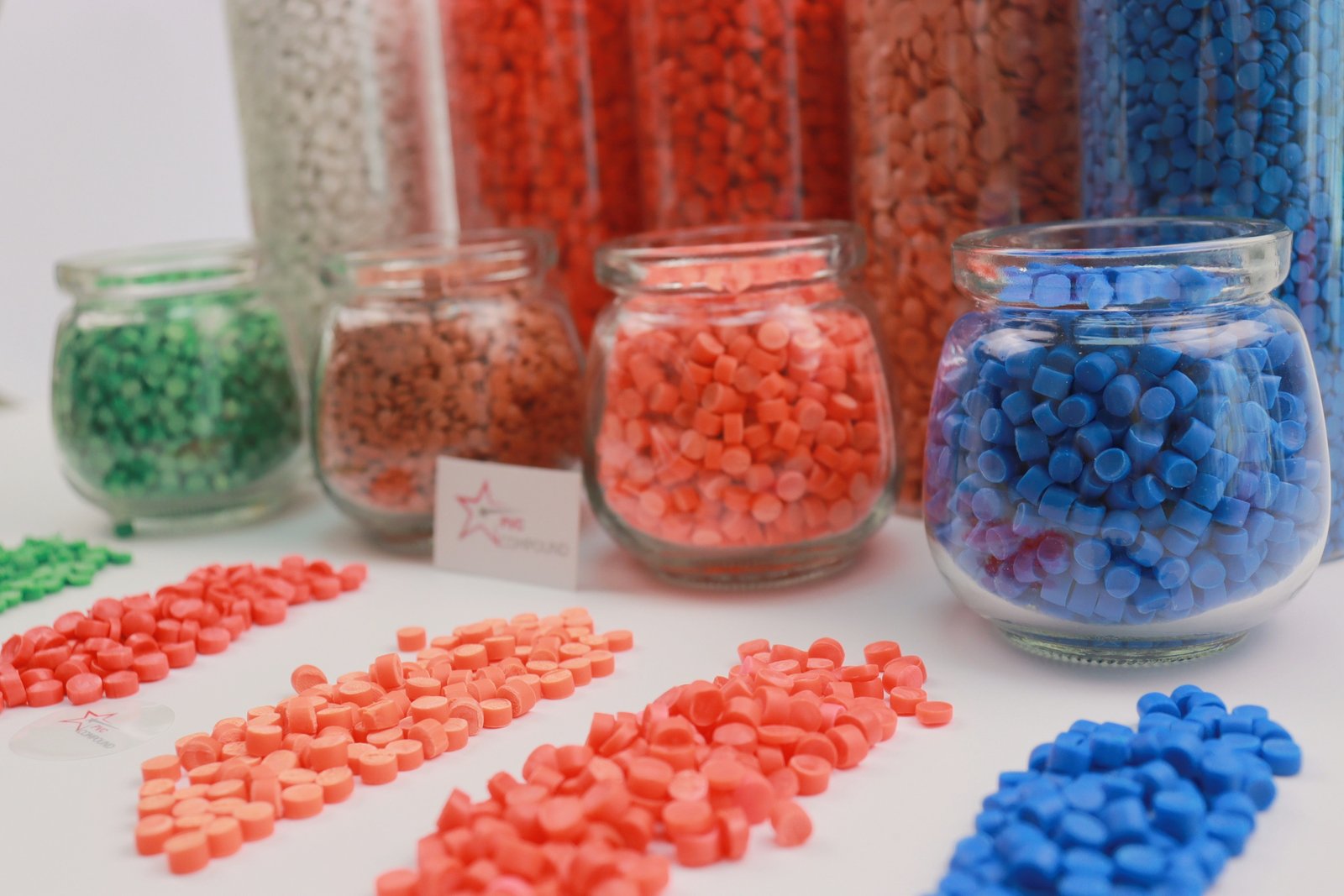
PVC compound is pre-formulated granules made by blending PVC resin with stabilizers, plasticizers, lubricants, and colorants6 in precise ratios, creating ready-to-use pellets for direct production.
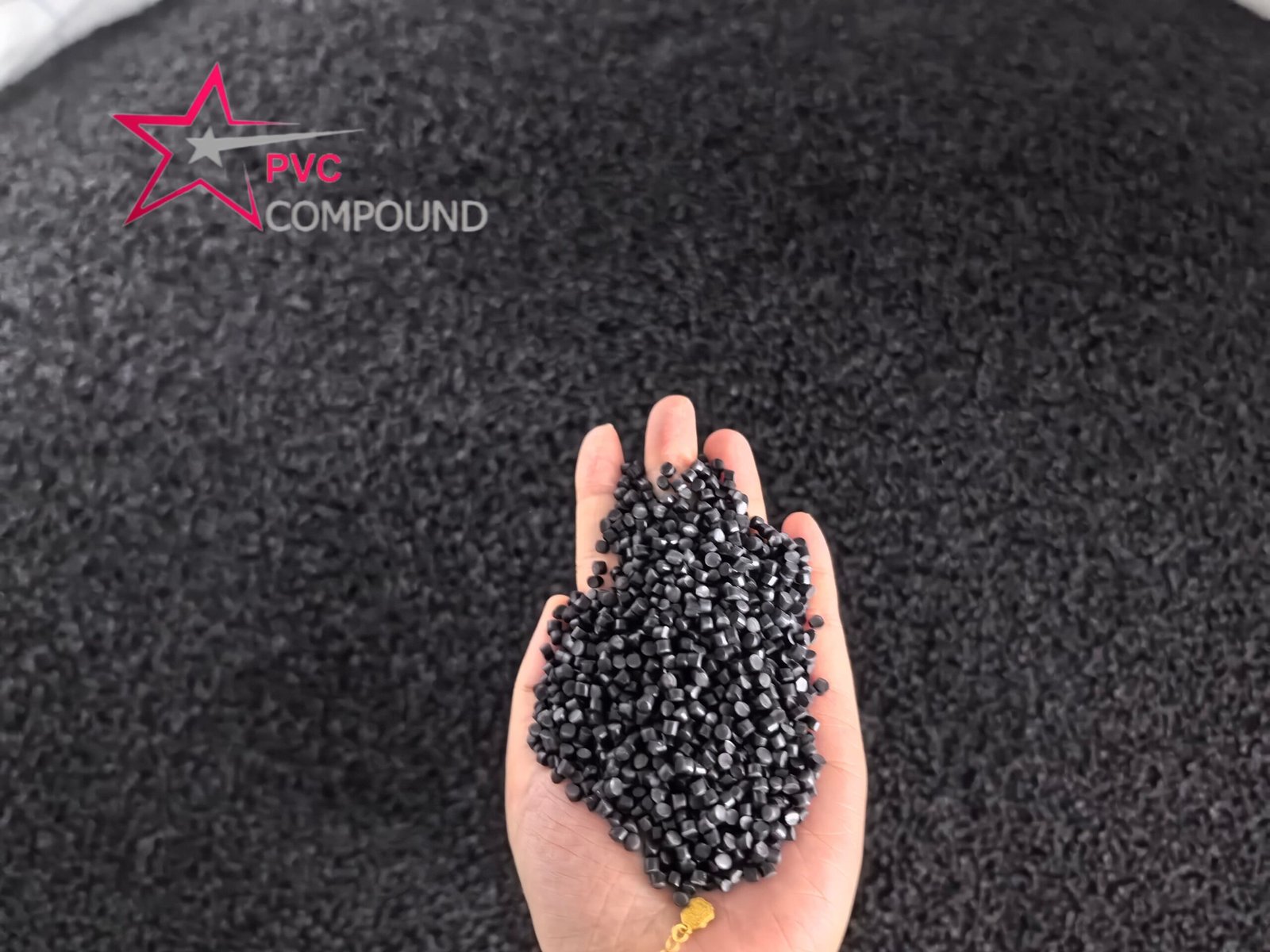
I remember working with a client in Germany who switched from resin to compound and reduced their setup time by 70%. The difference was dramatic. Instead of managing eight different raw materials, they handled one consistent product.
PVC compound represents completed formulation work. Each batch contains the exact ratio of additives needed for specific applications. When you open a bag of our compound, you're getting the result of precise engineering and quality control processes.
The manufacturing process involves several critical steps:
| Process Stage | Purpose | Quality Control |
|---|---|---|
| Recipe formulation | Optimize performance | Lab testing validation |
| Precision weighing | Ensure consistency | ±0.1% accuracy |
| High-intensity mixing | Homogeneous blending | Visual inspection |
| Twin-screw extrusion | Melt processing | Temperature monitoring |
| Pelletizing | Create uniform granules | Size distribution check |
What makes compound superior is the elimination of variables. Every pellet contains the same formulation. You don't need to worry about additive ratios, mixing uniformity, or batch-to-batch variations. The supplier handles these complexities for you.
How Do Physical Properties Affect Your Production Choice?
The physical differences between these materials directly impact your production line efficiency and product quality. Understanding these differences helps you make better sourcing decisions.
PVC resin appears as fine white powder requiring specialized handling equipment, while PVC compound comes as uniform solid granules that flow easily through standard processing machinery7.
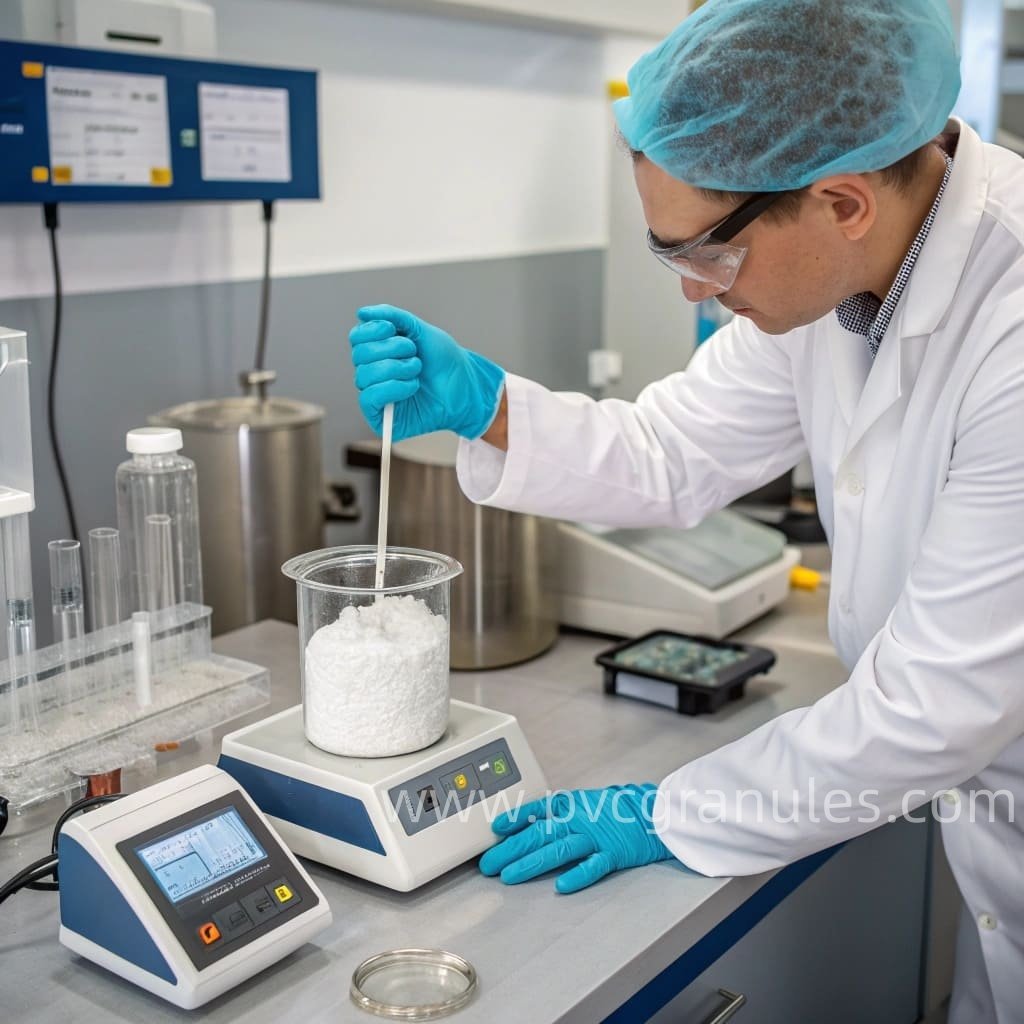
Working with powder creates challenges8 you might not anticipate. In our early days, we had customers complaining about dust problems, inconsistent feeding, and material waste. These issues disappeared when they switched to compound granules.
PVC resin powder has several handling limitations. The fine particles create dust clouds that require ventilation systems9. Static electricity causes powder to stick to equipment surfaces10. Moisture absorption leads to clumping problems. You need specialized pneumatic conveying systems to move powder efficiently.
The granule form provides consistent feeding into your processing equipment. Injection molding machines, extruders, and other equipment work more reliably with uniform pellets. You get better melt homogeneity and more consistent product dimensions.
I've seen production lines increase output by 15-20% simply by switching from powder to granules. The improved material flow reduces downtime and eliminates feeding problems that plague powder-based systems.
Which Performance Characteristics Matter Most for Your Application?
Performance flexibility separates these materials in ways that affect your product's market competitiveness. The right choice depends on your specific application requirements and customization needs.
PVC resin offers fixed properties suitable only for standard applications, while PVC compound provides customizable performance characteristics including hardness, weather resistance, and flexibility tailored to specific product requirements.
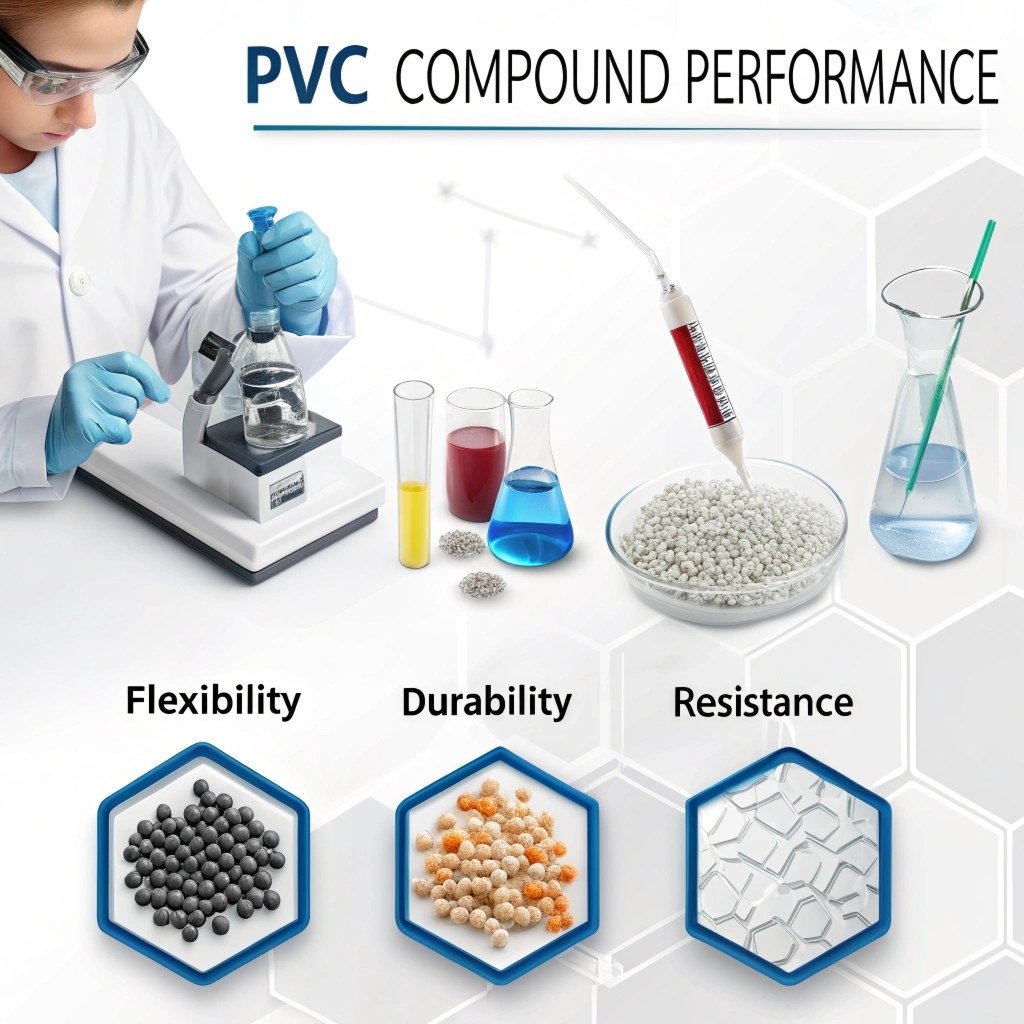
The performance gap becomes obvious when you need specialized properties. Last year, we helped a cable manufacturer in Brazil develop flame-retardant compound that met strict safety standards. This wouldn't have been possible with standard resin alone.
PVC resin limitations stem from its pure composition. Without additives, you get basic polymer properties that work for simple applications but fail in demanding environments. The material lacks thermal stability, UV resistance, and processing aids11 that modern applications require.
PVC compound opens up performance possibilities:
| Performance Area | Customization Options | Application Benefits |
|---|---|---|
| Hardness control | Shore A 40-95 | Flexible to rigid products |
| Weather resistance | UV stabilizers added | Outdoor applications |
| Temperature range | -40°C to +80°C | Extreme environment use |
| Flame retardancy | Halogen-free options | Safety compliance |
| Color matching | Custom color systems | Brand consistency |
The customization process involves precise formulation based on end-use requirements. We analyze your product specifications and develop compounds that deliver exact performance targets. This approach eliminates the trial-and-error process that comes with self-formulation.
I've worked with customers who needed compounds for medical applications requiring FDA approval, construction materials needing fire ratings, and automotive parts demanding impact resistance. Each application required different additive packages that would be impossible to achieve with basic resin alone.
How Do Cost Factors Influence Your Material Selection?
Understanding the total cost picture helps you make smarter purchasing decisions. The apparent price difference doesn't tell the complete financial story when you factor in processing requirements and operational efficiency.
PVC resin has lower unit costs but requires additional equipment and labor investments12, while PVC compound costs more per kilogram but eliminates infrastructure needs and reduces total production expenses.
I learned this lesson early when a customer in Thailand calculated their true costs. While resin appeared 15% cheaper, their total production costs were actually 8% higher due to additional processing requirements.
PVC resin's hidden costs include equipment investments for mixing, storage systems for multiple additives, quality control testing, and additional labor for material preparation. You also face inventory management complexity with multiple raw materials requiring different storage conditions.
Here's the complete cost breakdown:
| Cost Category | PVC Resin System | PVC Compound System |
|---|---|---|
| Material unit cost | Lower baseline | Higher per kg |
| Equipment investment | High mixing systems | Standard feeders only |
| Inventory management | Multiple SKUs | Single product |
| Quality control | Extensive testing | Incoming inspection |
| Labor requirements | Mixing operators | Reduced handling |
| Waste and rework | Higher variability | Consistent quality |
PVC compound delivers cost advantages through operational efficiency. You eliminate mixing equipment maintenance, reduce quality control testing, and minimize material waste from formulation errors. The consistent quality reduces rework and customer complaints.
The break-even point typically occurs around 500 tons annual consumption. Below this volume, compound economics work better. Above this threshold, companies with proper infrastructure might benefit from resin-based systems.
However, most manufacturers I work with find compound more cost-effective when they include all factors. The reduced complexity, faster startup times, and consistent quality create value that exceeds the higher material cost.
Conclusion
Choose PVC compound for ready-to-use convenience and consistent quality, or select PVC resin when you have mixing infrastructure and high-volume requirements.
"Polyvinyl chloride", https://en.wikipedia.org/wiki/Polyvinyl_chloride. A polymer science or encyclopedia source should support that PVC resin is the base polyvinyl chloride polymer supplied before compounding into application-specific formulations. Evidence role: definition; source type: encyclopedia. Supports: PVC resin is pure polymer powder that requires additional processing.. Scope note: The source may define PVC and resin generally rather than verify the article’s specific manufacturing framing. ↩
"PVC Compounding Explained: Formulation, Additives & ...", https://www.hywax.com/blog/pvc-compounding-process. A technical source on PVC processing should document that PVC resin is commonly compounded with additives before conversion into finished products. Evidence role: mechanism; source type: education. Supports: PVC resin requires additional processing before it can be used effectively in production equipment.. Scope note: The source may describe common industrial practice rather than prove that every PVC resin application requires the same processing steps. ↩
"Polyvinyl chloride", https://en.wikipedia.org/wiki/Polyvinyl_chloride. A plastics engineering source should support that PVC compounds are formulations of PVC resin and additives supplied as pellets or granules for direct processing. Evidence role: definition; source type: education. Supports: PVC compound is ready-to-use granules with pre-mixed additives.. Scope note: The source may describe PVC compound forms broadly and may not cover every supplier’s product format. ↩
"Vinyl chloride", https://en.wikipedia.org/wiki/Vinyl_chloride. An encyclopedia or institutional chemistry source should support that PVC is produced by polymerizing vinyl chloride monomer, which is industrially derived from ethylene and chlorine feedstocks. Evidence role: mechanism; source type: encyclopedia. Supports: PVC resin manufacturing begins with petroleum-derived feedstocks that undergo polymerization.. Scope note: The source may specify ethylene and chlorine rather than the broader phrase “petroleum derivatives.” ↩
"Features of Thermal Stabilization of PVC Modified with ... - PMC", https://pmc.ncbi.nlm.nih.gov/articles/PMC12349211/. A polymer degradation source should support that unmodified PVC is thermally unstable during processing and is commonly formulated with heat stabilizers to limit dehydrochlorination. Evidence role: mechanism; source type: paper. Supports: Pure PVC resin has poor thermal stability during heat processing and requires heat stabilizers.. Scope note: The source supports the general thermal degradation mechanism and stabilizer use, not the exact wording of the table. ↩
"New Biobased Plasticizers for PVC Derived from Saturated ...", https://pmc.ncbi.nlm.nih.gov/articles/PMC12072859/. A technical source on PVC formulation should support that common PVC compounds include additive classes such as stabilizers, plasticizers, lubricants, fillers, pigments, or colorants depending on application. Evidence role: definition; source type: education. Supports: PVC compound is made by blending PVC resin with additive classes including stabilizers, plasticizers, lubricants, and colorants.. Scope note: Exact additive packages vary by product, so the source would support the typical categories rather than the precise formulation of any specific compound. ↩
"Flowability and handling characteristics of bulk solids ...", https://www.academia.edu/22221499/Flowability_and_handling_characteristics_of_bulk_solids_and_powders_a_review_with_implications_for_DDGS. A plastics-processing or bulk-solids source should support that pelletized or granulated polymers generally improve feeding and conveying consistency compared with fine powders. Evidence role: mechanism; source type: education. Supports: PVC compound granules tend to flow more easily through standard processing machinery than fine PVC powder.. Scope note: The source would support the general advantage of pelletized polymers; actual flow behavior still depends on granule size, formulation, moisture, and equipment design. ↩
"Measurement of electrostatic charging during pneumatic ...", https://www.sciencedirect.com/science/article/abs/pii/S0950423017301389. A powder-handling or occupational safety source should support that fine powders can create handling challenges such as dust generation, flow problems, and exposure-control requirements. Evidence role: general_support; source type: government. Supports: Powder-form PVC resin can create handling challenges in production environments.. Scope note: The source may address industrial powders generally rather than PVC resin powder specifically. ↩
"Safety Data Sheet PVC Resin (All Grades)", https://redox.com/wp-content/sds/4054.pdf. An occupational safety source should support that airborne dust from handling powders is controlled through engineering measures such as local exhaust ventilation and dust collection. Evidence role: expert_consensus; source type: government. Supports: Fine PVC resin particles can create dust clouds that may require ventilation or dust-control systems.. Scope note: The source may discuss nuisance or combustible dusts broadly and may not be specific to PVC resin in all settings. ↩
"Surface Chemistry and Humidity in Powder Electrostatics - PMC - NIH", https://pmc.ncbi.nlm.nih.gov/articles/PMC6641046/. A powder technology source should support that electrostatic charging during powder handling can cause adhesion to equipment surfaces and interfere with powder flow. Evidence role: mechanism; source type: research. Supports: Static electricity can cause powder to adhere to equipment surfaces during handling.. Scope note: The source may describe electrostatic effects in powders generally rather than PVC resin specifically. ↩
"Surface Chalking upon Weathering of Dark-Colored PVC ...", https://pmc.ncbi.nlm.nih.gov/articles/PMC11053820/. A PVC formulation source should support that additives such as heat stabilizers, UV stabilizers, plasticizers, lubricants, and processing aids are used to improve PVC’s processing and service performance. Evidence role: mechanism; source type: paper. Supports: Uncompounded PVC resin lacks key performance aids such as thermal stabilization, UV protection, and processing aids for demanding applications.. Scope note: The source supports the need for additives to enhance PVC performance, but the exact deficiency level depends on resin grade and application. ↩
"Plastic Compounding Market Size, Share, Growth, Analysis ...", https://straitsresearch.com/report/plastic-compounding-market. A manufacturing economics or plastics compounding source should support that using raw resin can shift costs from purchased material to in-house compounding equipment, additive inventory, quality control, and labor. Evidence role: general_support; source type: education. Supports: PVC resin may have lower unit costs but can require additional equipment and labor investments for compounding and processing.. Scope note: The source may support the cost categories qualitatively rather than quantify the article’s specific cost comparison for every factory. ↩
